
Home » Wedding Speech 2026: The Trends Redefining Modern Weddings
(*Of course, if you’re looking for more than ‘advice’, check out all the different ways the Speechy team can help you write & deliver a great speech. Or check out our new AI-powered team member, SpeechyAI.)
‘(Of course, if you’re looking for more than ‘advice’, check out Speechy’s bespoke speechwriting service. We also have a range of excellent speech templates that might be just what you need.)
(*Of course, if you’re looking for more than ‘advice’, check out our eulogy writing service or our eulogy template.)
(Of course, if you’re looking for more than ‘advice’, check out Speechy’s bespoke speechwriting service. We also have a range of excellent speech templates that might be just what you need.)

Getting married is supposed to be the nerve-wracking part.
Yet for many couples planning a Wedding Speech 2026, it is not the ceremony that keeps them awake at night. It is the moment someone picks up a microphone.
New research from Speechy, based on a survey of 234 couples getting married in 2026, reveals a striking shift in wedding culture:
The numbers reveal just how high-stakes wedding speeches now feel:
This is not stage fright. It is something more modern, and more revealing.
When couples talk about anxiety around a Wedding Speech 2026, they are rarely worried about public speaking.
They are worried about:
As Speechy founder Heidi Ellert-McDermott puts it:
“People aren’t scared of standing up. They’re scared of the social consequences. Wedding speeches now feel like reputational moments, not just tradition.”
In an era where weddings are filmed, shared, clipped, and replayed, speeches have stopped being ephemeral. They live on. Couples know it.
What the data shows is not panic, but intentionality.
Couples are no longer treating speeches as a harmless box-ticking exercise. They are curating them with the same care as the guest list, the playlist, and the seating plan.
From our 2026 research and thousands of real-world speeches, several wedding speech trends are emerging:
As Heidi notes:
“Wedding speeches are being managed like risk, but the aim isn’t control. It’s generosity. Couples want guests to enjoy the moment, not endure it.”

Perhaps the most visible change in Wedding Speech 2026 culture is the groom speech.
For years, the formula was predictable: mock yourself, apologise to your partner, thank everyone within eyesight, sit down relieved.
That approach is starting to feel dated.
Today’s groom speeches are:
This reflects a wider cultural shift. Emotional intelligence in men is no longer niche. Vulnerability is no longer framed as weakness. And weddings have become one of the clearest stages on which this plays out.
“We’re watching masculinity being rewritten in real time, one wedding speech at a time,” says Heidi. “The mic hasn’t changed, but what guests expect from the person holding it absolutely has.”
One of the most striking findings in our Wedding Speech 2026 data is the tension around AI. Nearly a quarter of grooms-to-be say they would consider using AI to help write their wedding speech, yet only 6% of brides-to-be say they would be happy for their partner to do so.
At first glance, that looks like a hard no. But dig a little deeper and the picture is more nuanced.
Do partners really prefer a speech that is rambling, under-prepared, or quietly disastrous… over one that has had a helping hand?
Heidi Ellert-McDermott, founder of Speechy, thinks the fear is less about technology and more about tone:
“I think people worry AI will make a speech sound generic or clichéd. But actually, using the right AI tool does the opposite. It stops you falling into Pinterest quotes and tired lines, and helps you get the best out of your own stories and voice. It’s much closer to working with a professional speechwriter than outsourcing your personality.”
In other words, when used properly, AI is not replacing the human element of a wedding speech. It is supporting it. Providing structure, clarity, and confidence, while leaving the emotion, humour, and authenticity firmly with the speaker.
For many couples navigating Wedding Speech 2026, the question may not be “Should we use AI?” but “What kind of help actually leads to a better moment in the room?”
Check out SpeechyAI to see if it’s right for you two. Reviews and examples.
Modern weddings are more intentional. More guest-aware. More curated.
In that context, speeches are no longer filler between courses. They are moments that can lift the room or drain it. Couples know this. Which is why so many now fear them.
Yet there is something hopeful in that fear.
It shows that people care. They want speeches that feel generous rather than indulgent. Human rather than rehearsed. Worth listening to.
As Heidi puts it:
“Couples aren’t chasing perfection. They’re trying to create a moment that feels generous, relaxed, and genuinely enjoyable for everyone in the room. That desire to look after their guests is a very modern instinct.”
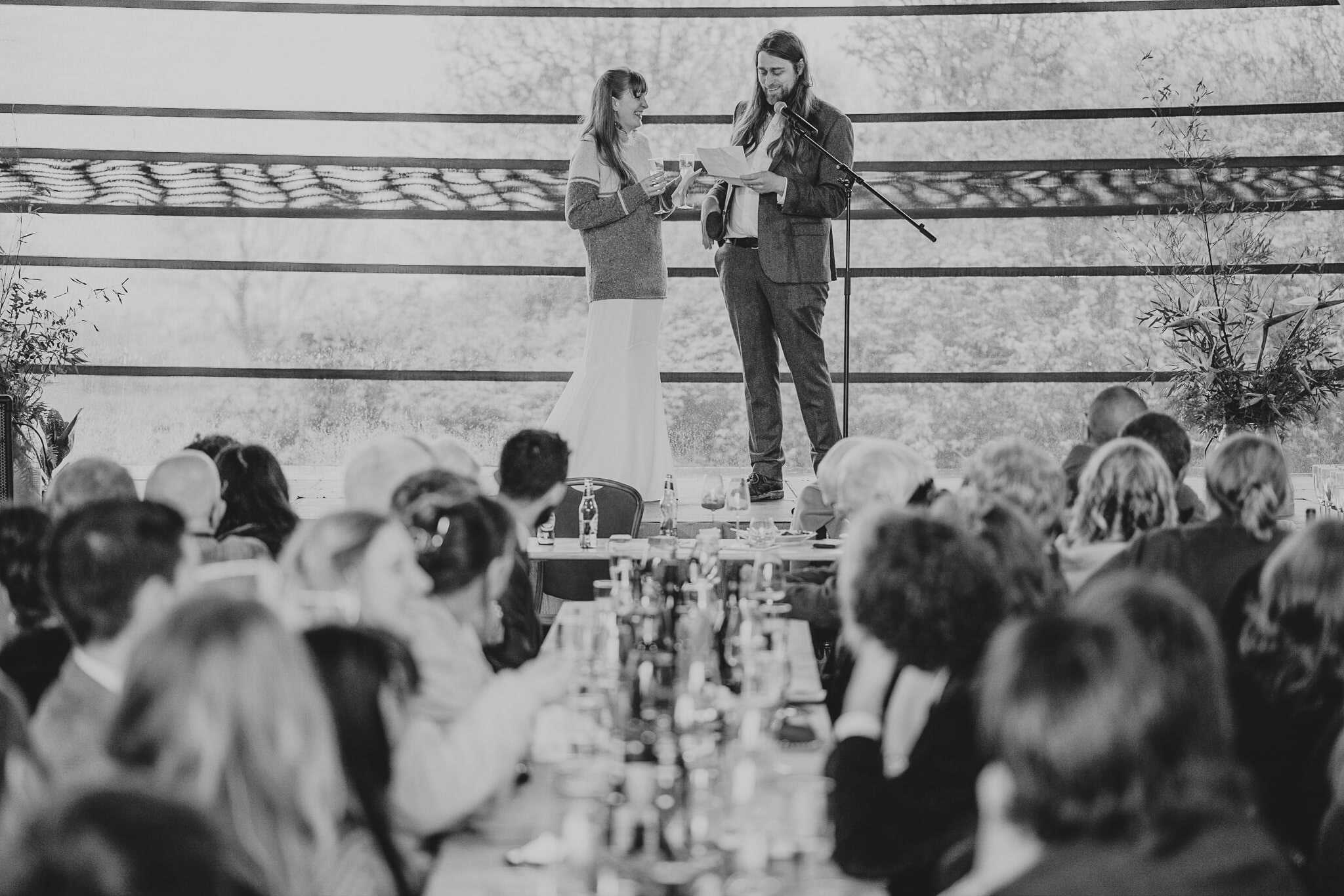
Wedding speeches are having a cultural moment.
They reflect how couples see themselves, how relationships are evolving, how attention has become precious, and how tradition is being gently rewritten rather than abandoned.
The microphone is the same. But expectations around a Wedding Speech 2026 are not.
The Speechy team are TV-trained scriptwriters/comedians by trade & we’ve helped 1,000s of speakers around the world deliver their dream speech.
Our advice has been quoted everywhere from The New York Times to Grazia and from Forbes to The Observer. Our founder has also featured on the BBC Sounds’ Best Men podcast with Jason Manford and written ‘The Modern Couple’s Guide to Wedding Speeches’, published by Little, Brown.


